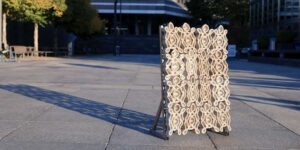
Virginia Tech Unveils 3D Printed Evaporative Cooling Ceramic Partitions
Researchers at Virginia Tech have developed 3D printed clay and porcelain partitions that leverage ancient evaporative cooling to lower indoor temperatures by over 5.5 °C. Using specialized surface geometry and unglazed ceramic modules, the passive system offers a low-carbon alternative to modern air conditioning.
Published: July 4, 2025 • Original report: 2025-07-01

In response to rising global temperatures and increasingly dangerous heat waves, a collaborative group of architects and researchers at Virginia Tech has turned to centuries-old climate solutions, modernizing them through digital fabrication. The initiative, titled the Evaporative Cooling Partitions (ECP) project, revives ancient passive cooling methods once common across Asia and the Middle East, updating them with contemporary additive manufacturing.
Led by industrial designer Brook Kennedy, architect Stefan Al, and building construction professor Georg Reichard, the team aims to establish sustainable, low-carbon strategies for the built environment. By combining computational design with ceramic extrusion, the team has engineered architectural dividers that naturally lower indoor ambient temperatures without relying on energy-intensive mechanical air conditioning.
Key Highlights & Specifications
- Research Institution: Virginia Tech (featuring researchers from Industrial Design, Architecture, and the Myers-Lawson School of Construction).
- Project Designation: Evaporative Cooling Partitions (ECP).
- Hardware Employed: WASP 3D printer for ceramic prototyping.
- Materials Used: Unglazed natural clay and porcelain composites, with ongoing inquiries into biomineralized materials.
- Thermal Performance: Capable of dropping ambient air temperatures by more than 5.5 °C (10 °F).
- Internal Medium: Hollow internal cavities backfilled with a combination of sand and water.
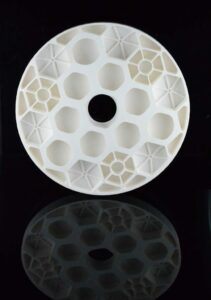
- Modular Assembly: Composed of interlocking, elongated 3D printed components.
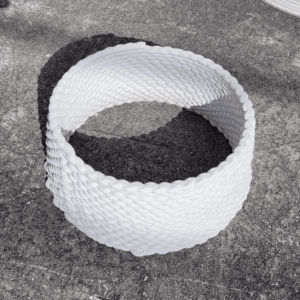
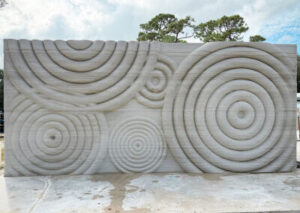
- Surface Optimization: Digitally modeled high-texture surface finishes engineered specifically to maximize evaporation rates.
- Testing Methodology: Thermal validation conducted via FLIR infrared thermal cameras and evaporation measured in dedicated humidity chambers.
- Recognition: Documented through the Green Good Design Award program.
Mechanics of Evaporation: Materials, Extrusion, and Geometry
The core operating mechanism relies on the natural physics of porous ceramics. When hot ambient air moves across a damp, unglazed earthenware or porcelain boundary, moisture drawn from the internal core absorbs thermal energy and evaporates, reducing the temperature of the surrounding air stream. In the ECP project, this ancient thermodynamic principle is updated using parametric modeling to create intricate exterior surface textures that dramatically expand the active surface area exposed to ambient airflow.
The structural partitions are manufactured via clay extrusion on a WASP 3D printing system into elongated, interlocking segments. Crucially, the exterior remains completely unglazed, preserving the open microporosity of the ceramic matrix so water can continuously weep toward the surface. The hollow central volume of each stacked column is packed with wet sand, providing both a structural thermal mass and a steady, slow-releasing hydration reservoir that sustains the evaporative cycle over extended durations.
Implications for Ceramic Architecture and Earthen Additive Manufacturing
For ceramicists, architects, and earthen 3D printing practitioners, the ECP project validates the emerging discipline of neo-archaic architectural research. While functional clay additive manufacturing often centers on complex aesthetics or basic structural masonry, this initiative demonstrates how tuned clay porosity, material composition, and parametric form can yield performative building systems that actively regulate interior microclimates.
By verifying performance using FLIR infrared imagery and humidity sensors, the Virginia Tech team establishes that 3D printed ceramics can serve practical environmental roles in modern infrastructure. Furthermore, as the team explores biomineralized materials alongside traditional clay and porcelain bodies, this approach opens new possibilities for sustainable, zero-emission climate solutions in contemporary architecture.
Source & Project Documentation
Primary Sources:
Related Links & Files: