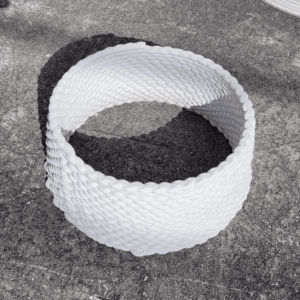
Brian Peters’ Coded Clay Studio Explores Multi-Material Ceramic 3D Printing
Artists are employing clay additive manufacturing techniques to create sculptures that mimic the appearance of woven textiles. This application demonstrates the capacity of ceramic printing to achieve intricate surface textures.
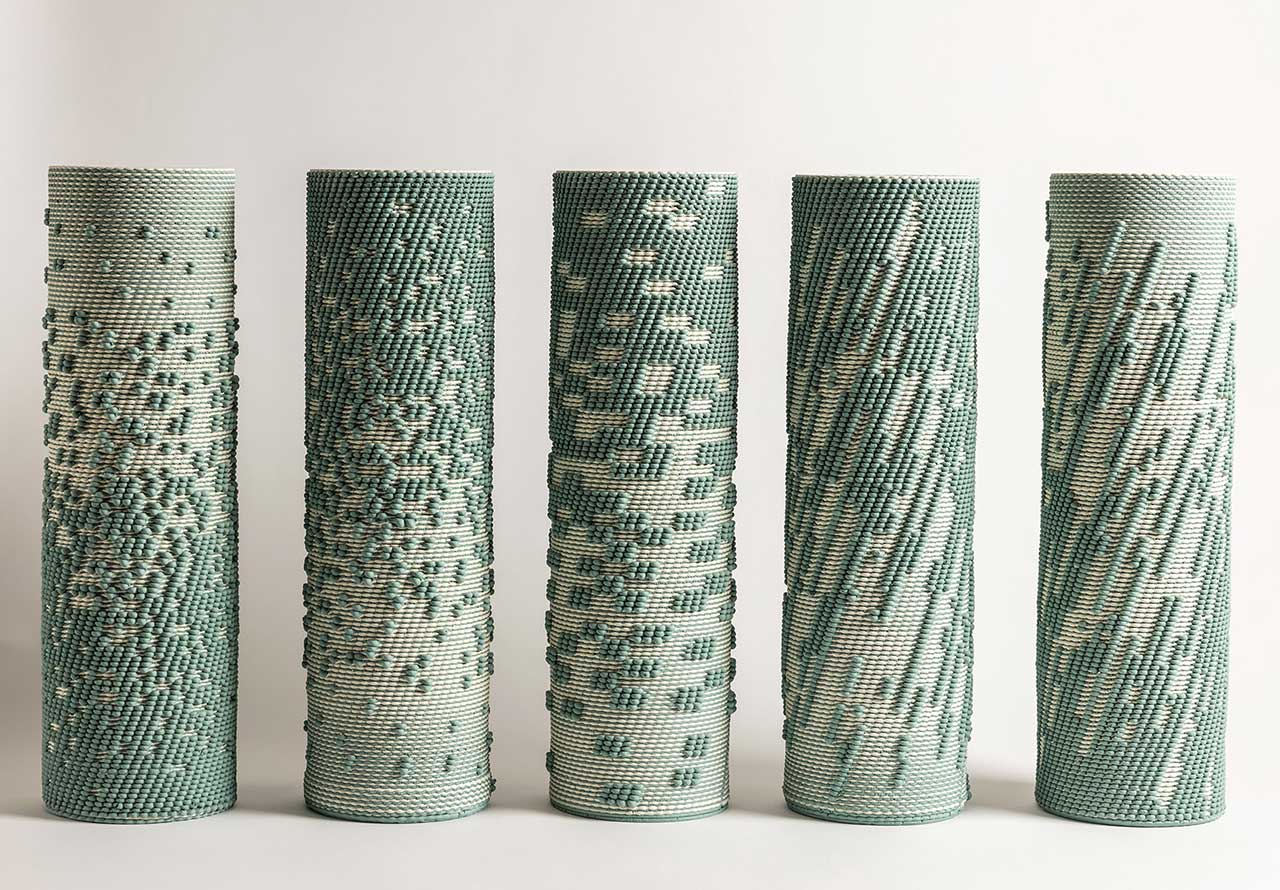
Pittsburgh-based architect and artist Brian Peters produces digitally designed ceramic homewares and architectural installations through his design studio, Coded Clay. Established in 2018 alongside his primary architectural practice, Brian Peters Studio, the studio combines custom parametric coding and self-built 3D printers with hand-finishing and kiln firing.
Peters holds a BA in Studio Art and a Master of Architecture. His work with ceramic additive manufacturing began in 2012 during a residency at the European Ceramic Workcentre (EKWC) in Oisterwijk, Netherlands, where he developed Building Bytes, a project focused on 3D-printed modular ceramic bricks for construction. He also previously worked with DUS Architects in Amsterdam on large-scale 3D printers before launching Coded Clay to focus on smaller domestic objects.
Key Facts & Specifications
- Founder & Studio: Brian Peters, founder of Coded Clay (established 2018) and Brian Peters Studio, based in Pittsburgh, Pennsylvania.
- Background: Residency at the European Ceramic Workcentre (EKWC) in Oisterwijk, Netherlands (2012); prior collaboration with DUS Architects in Amsterdam.
- Hardware: Custom-built 3D clay printers, including multi-extruder setups capable of printing two distinct colors of clay simultaneously.
- Materials: Natural earthenware and stoneware clays, selectively finished with interior or hand-applied glazes.
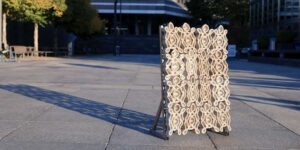
- Notable Works: Building Bytes (modular bricks), the Strata collection, the dual-colored Dyadic series, Prairie Cord at Olbrich Botanical Gardens, and the Eighth and Penn lobby screen in Pittsburgh.
Parametric Toolpaths and Multi-Extruder Fabrication
Peters begins his design workflow with sketches that are converted into 3D geometries via custom parametric code. This approach enables the generation of surface rhythms, cellular structures, and looping toolpaths that cannot be produced through wheel-throwing or slip-casting.
For recent collections such as the Dyadic series, Peters developed custom multi-extruder hardware to interlace two differently colored raw clays during a single print run. This dual-extrusion method creates textile-like surface patterns directly from the clay bodies rather than relying on post-print surface glazes. Once printed, each vessel is refined by hand, air-dried, and kiln-fired, with functional items such as vases receiving an interior glaze to ensure watertightness while leaving the extruded exterior texture raw.

Relevant Photo Sources
Project & Editorial Sources:
- Coded Clay Official Website (Homewares & Multi-Color Vessels): codedclay.com
- Brian Peters Studio (Architectural Screens & Building Bytes): brian-peters.com
- Colossal Feature on the Dyadic Series (Dual-Extruder Process & Close-Ups): thisiscolossal.com
- Dezeen Feature on Building Bytes (EKWC Residency & 3D-Printed Bricks): dezeen.com