Emerging Objects Unveils 3D Printed Cabin of Curiosities
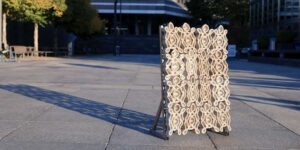
Emerging Objects has revealed a one-room gabled structure clad in over 4,500 custom 3D printed ceramic tiles. The project showcases innovative modular additive manufacturing and sustainable architectural cladding.
Published: March 16, 2018 • Original report: 2018-03-13

In the rapidly evolving landscape of construction additive manufacturing, California-based studio Emerging Objects continues to carve out a unique niche. Spearheaded by UC Berkeley professors and architects Ronald Rael and Virginia San Fratello, the firm stands apart as a pioneer by championing a modular approach centered on 3D printed bricks and tiles rather than monolithic concrete extrusion. Their latest endeavor, the Cabin of Curiosities, serves as a comprehensive synthesis of the company’s extensive material research and design philosophy.
Functioning as a compelling proof-of-concept investigation, the one-room gabled structure explores the architectural potential of upcycled materials and custom 3D printed claddings to address 21st-century housing challenges. The building acts as a physical archive, bringing together a diverse collection of tile and cladding assemblies ranging from interior translucent glowing walls to sophisticated exterior rain screens featuring integrated planters and textural clay shingles.
Key Highlights & Specifications
- Structure Type: One-room gabled architectural proof-of-concept cabin.
- Exterior Cladding: Over 4,500 custom 3D printed ceramic tiles.
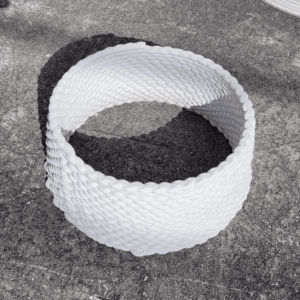
- Tile Varieties: Integrated “planter” tiles on the gable ends and shingled “seed stitch” tiles wrapping the side walls and roof.
- Material Innovation: Utilization of upcycled agricultural and industrial waste, including salt, cement, paper, and sawdust.
- Design Aesthetics: Zero identical tiles, creating unique shadow lines and a distinct handmade look.
Materials, Extrusion Workflow, and Fabrication
Emerging Objects pushes the boundaries of material science in additive manufacturing while cleverly relying on open-source tools and standard off-the-shelf 3D printers. The exterior facade highlights two distinct styles of ceramic components: planter tiles designed with built-in pockets for vegetation to grow, and seed stitch tiles that borrow structural terminology from knitting. The latter are produced via a deliberately rapid printing workflow, employing advanced G-code processing to meticulously govern individual lines of clay. This precise digital control intentionally introduces minor variations, yielding an organic, handcrafted aesthetic where no two pieces are identical.
Implications for Ceramic Artists, Architects, and Makers
This innovative project signals a major shift for ceramic artists, architects, and makers exploring the intersection of digital fabrication and sustainable design. By demonstrating how standard hardware can be paired with sophisticated G-code programming, the Cabin of Curiosities proves that mass-customization is entirely achievable in ceramic architecture. Furthermore, the studio’s commitment to integrating upcycled agricultural and industrial waste offers a sustainable roadmap for the future of building envelopes, opening up new creative avenues for functional and decorative earthen structures.
Source & Project Documentation
Primary Sources: