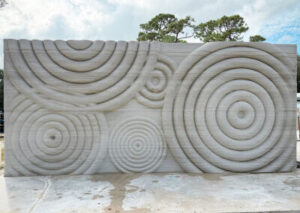
WASP to Live-Print Clay Coral Reef Modules at Formnext 2024
Italian 3D printing manufacturer WASP will showcase live clay printing of coral reef modules alongside sustainable geopolymer and pellet recycling technologies at Formnext 2024. The demonstrations highlight how ceramic and earthen additive manufacturing can support marine restoration and low-carbon architecture.
Published: November 17, 2024 • Original report: 2024-11-14

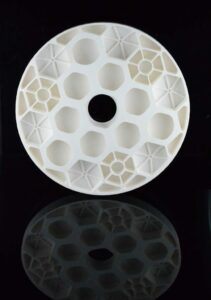
Italian additive manufacturing pioneer WASP is set to place sustainability at the center of its showcase at Formnext 2024 in Germany. Visitors to the company’s booth (B101 in Hall 12.1) will witness live 3D clay printing of artificial coral reef modules, a project developed in collaboration with Zurich-based startup rrreefs to help restore threatened coastal and aquatic ecosystems.
Coral reefs rank among the planet’s most biodiverse habitats, yet they face severe pressure from climate change, pollution, and overfishing. By pairing industrial-scale ceramic additive manufacturing with ecological research, WASP and rrreefs aim to demonstrate how 3D-printed earthenware structures can actively support marine recovery.
Alongside the live coral reef production, WASP will highlight a broader portfolio of low-impact technologies at the expo. These include a geopolymer architectural column created with Eindhoven University, as well as several closed-loop thermoplastic pellet systems designed to minimize waste and energy consumption.
Key Highlights & Specifications
- Live Coral Reef Printing: Two WASP 40100 Production systems will operate live at booth B101 (Hall 12.1), extruding earthenware clay modules designed for rrreefs.
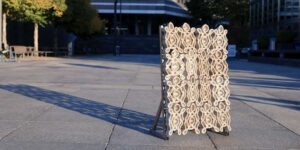
- Geopolymer Column: Developed with Eindhoven University and displayed at the BE-AM stand (F49, Hall 11.0), this structure uses geopolymers that produce up to 80% less CO2 emissions than conventional cement while retaining architectural strength and resistance.
- RIGENERA Recycling Station: A plastic waste-to-feedstock system featuring a collection module, chainsaw and plastic shredder, and dehumidifier, capable of connecting directly to WASP pellet extruders—including setups using the CEREBRO robotic arm.
- METAMORFOSI Pellet Platform: A multi-color pellet printing system utilizing cyan, magenta, yellow, and key (black) to blend and adjust hues in real time during printing.
- Power WASP 45 HDP: A large-scale Fused Granular Fabrication (FGF) printer capable of 45-degree angled printing to reduce support structures, material waste, and post-processing.
- WASP Extruder HDP XXL: A high-capacity thermoplastic pellet extruder built for robotic arm integration via CEREBRO and full compatibility with the RIGENERA system.
Materials, Extrusion, and Closed-Loop Workflows
For the coral reef initiative, WASP’s 40100 Production printers will extrude a specialized earthenware clay formulation. According to the project partners, this ceramic substrate has proven effective at encouraging coral larvae to attach and thrive, turning printed geometries into functional marine habitats.
In the architectural sphere, the Geopolymer Column illustrates how mineral-based binders can replace traditional Portland cement in large-scale extrusion. By significantly cutting carbon emissions during material production without sacrificing structural integrity, geopolymers offer a viable path forward for earthen and concrete 3D printing.
WASP’s thermoplastic demonstrations follow a similarly circular workflow. The RIGENERA station shreds and dehumidifies discarded plastic, feeding it directly into pellet-based extruders like the HDP XXL or the multi-color METAMORFOSI platform. Combined with 45-degree angled slicing on the Power WASP 45 HDP, these workflows reduce both raw material consumption and post-printing labor.
What This Means for Ceramic Artists, Architects, and Makers
WASP’s Formnext 2024 lineup underscores a growing shift in ceramic and earthen additive manufacturing: moving beyond studio prototypes toward measurable environmental impact. For ceramicists and ecological designers, the rrreefs collaboration proves that standard earthenware clay—when paired with reliable production hardware like the 40100—can serve demanding outdoor and underwater applications.
For architects and construction innovators, the Eindhoven University geopolymer column reinforces the viability of low-carbon binders for structural elements. As regulations around embodied carbon tighten, having access to printable materials that slash CO2 emissions by up to 80% will be increasingly valuable.
Finally, for makers and industrial fabricators, the integration of recycling stations like RIGENERA with robotic and large-format extruders points toward a more self-sufficient studio and factory model, where waste streams are converted directly into functional, multi-material outputs.
Source & Project Documentation
Primary Sources: